Search this Site

Showing posts with label FLSA. Show all posts

Tuesday, June 21, 2011

Settlement Delayed, Settlement Denied Part 5: Individual Checks Will be Distributed by July 22, 2011

Image courtesy from Renjith Krishnan/FreeDigitalPhotos.net
New Post as of July 29: Settlement Delayed Part 6: Checks Are Here!


Last Updated June 22, 2011 12:05am PST
Last Updated June 22, 2011  6:00 pm PST
Last Updated June 29, 2011 8:51 pm PST (Author added a countdown clock)


Dear Readers,

We have the latest update of the Settlement Claims as of June 20, 2011.

Finally, after six grueling months of waiting for our individual settlement checks to be released, due to various reasons and delays, there we see a bright light at the end of the tunnel.

I would like to take opportunity to dispel rumors that have been circulating and percolating the blogosphere about the date for the distribution of individual checks to tens of thousands of eligible claimants. Many of us have been advised from other groups, from individuals, from our friends, or even from Rust Consulting associates that individual settlement checks will be distributed this June.

That is incorrect. Distribution of individual checks will likely be on July 22, 2011, according to Court order. Here, I added countdown clock (based on PST US and Canada) for everybody's convenience, until the date when you and I should be expecting a settlement check:


Based on the latest stipulations by the Court, here's the final words from Magistrate Judge Joseph Spero in his Court decision as ordered dated June 20, 2011:

"WHEREAS settlement class members are guaranteed at least $12,599,452.37 of the settlement amount; WHEREAS individual settlement awards will likely be distributed by July 22, 2011;"

That statement alone should clarify the expected date for the distribution of individual checks. But if you look closely how the statement was being worded, you would observe that the court's statement seemed not a rock solid assertion as far as the actual date of distribution is concerned.

Note the phrase from the statement above, "...awards will likely be distributed..." (italics and emphasis mine). A more assertive statement would have been, "...awards will be distributed..." Did you spot the difference?

Now, when you call Rust Consulting, what you hear is nothing but uncertain distribution dates. Their associates would say end of June. Others say first week of July. Truth of the matter is, they have not sent any checks yet. I think it is more realistic to believe and rely on the court's statement about the distribution date and let us stick our hopes to that date... for now. After all, it is the court that controls this settlement. Rust Consulting simply follows a court order. Rust has no legal power to distribute checks outside of an order.

Furthermore, the following are important part of the court order which details the costs, fees, and administrative charges of the settlement. Here's the exact words from Judge Joseph Spero:

"WHEREAS the amount of the settlement fund remaining after deductions for Court-approved attorneys’ fees and costs, service awards, settlement administrator’s charges and costs, and PAGA penalties is $12,995,851.28, as detailed below:"

TOTAL SETTLEMENT AMOUNT:                                        $27,000,000.00

Attorneys’ Fees Awarded                                                             -$11,307,449.62
Costs to Schneider Wallace Cottrell Brayton Konecky LLP           -$  1,598,589.41
Costs to Grady Schneider LLP                                                     -$    217,323.64
Costs to Goldstein Demchak Baller Borgen & Dardarian               -$       24,000.00
Costs to Bailey Pinney & Associates LLC                                    -$     107,427.39
Amount Reserved for Future Attorneys’ Fees                               -$     144,375.57
Twenty $5,000 Service Awards                                                    -$     100,000.00
One $2,500 Service Award                                                           -$         2,500.00
Two $1,000 Service Awards                                                         -$         2,000.00
One $500 Service Award                                                              -$            500.00
Amount Allocated to PAGA                                                         -$      100,000.00
Settlement Administration Costs for Rust Consulting, Inc.             -$      399,983.09

TOTAL REMAINING                                                                $12,995,851.28

From the allocation of settlement above, more than half of the settlement money went to fees and cost alone. There is also a fee being allocated to PAGA (Private Attorney General Act of 2004) amounting to $100,000.00 which has never mentioned previously.

As far as the settlement tax that will be deducted allegedly from the settlement money, the court didn't mention in its stipulation. But I will not be surprised when a deduction will be excised at a later period. I hope it won't.

Another thing that should concern everybody: Remember when you received a letter from Rust Consulting last November 2010 about the Official Court Notice of Settlement where the expected amount you will likely to receive for the settlement was mentioned in that notice? Well, don't be surprised when there will be significant changes in respect to the amount you would receive from the mail. To be honest, I expect some confusion the moment you get your own individual check when comparing it with the original notice. I can almost guarantee that. We are talking about more than 30,000 former and active RGIS employees here hungry for fairness and compensation.  

In his final and concluding statement, Judge Joseph Spero became more revealing about a Reserve Fund being allocated in excess of the $399,983.09 that is already included in Rust Consulting's invoice. The following are his: 

"The Court, having reviewed the parties’ stipulation, and good cause appearing, hereby ORDERS as follows: 

(1) a Reserve Fund in the amount of $150,000.00 will be withheld from the settlement fund for the sole purpose of providing settlement awards to eligible settlement class members who may be inadvertently omitted from the initial settlement fund distribution, and to pay Rust Consulting, Inc. for any related administration charges and/or costs in excess of the $399,983.09 already included in Rust Consulting’s June 15, 2011 invoice; and

(2) any residual monies left in the Reserve Fund 180 days after the initial distribution of the individual settlement awards will be distributed evenly to the cy pres recipients identified in Section 2.12(G) of the Settlement Agreement.

IT IS SO ORDERED."

The court has mentioned about "cy pres" recipients. What is it?

The term has been applied in the context of class action settlement specifically in the United States. It allows the court to amend the terms of the trust or settlement fund as closely as possible to the original intention of the settlor to prevent the said trust from failing. This happens when the original objective of the settlor became impossible, or illegal to perform. In short, it is a protection clause that a court can perform favorably both for the recipients (or beneficiaries) and the settlor.

Finally, the rest of the stipulations did not mention how the distribution of the individual checks will be implemented but we TRUST RUST Consulting to perform well as the settlement administrator. 

To Rust Consulting:
You are being paid close to $400 Thousand just to perform this job description. If you can update information on claims for a lawnmower product that you previously administered, which fees were not even close to the amount you get from RGIS Settlement Claims, why can't you update us in a more timely and accurate manner? Give us good reasons this time that you perform well and beyond the plaintiffs' expectations and satisfaction.

Rust Consulting is open to comment and share information pertinent to the case.  

We also hope the court shall stand by its words.


Tuesday, May 17, 2011

Settlement Delayed, Settlement Denied Part 4: Delaying Tactic or Delaying Antic?

Image courtesy of Salvatore Vuono / FreeDigitalPhotos.net


New Post as of July 29: Settlement Delayed Part 6: Checks Are Here!


Supplemental Updates as of May 13, 2011

Dear Readers,

After the last batch of plaintiffs that filed opt-ins in January 2011, another cause of this already delayed settlement case, but this time, from the very lawyers of the Plaintiffs. I was surprised because the issue with them is not about attorneys' fees. As everyone knows, they gladly accepted their fees in the amount of $11,321,849.62 in total. But the issue this time is on material expenses and cost they incurred during the litigation of this case.

It is ironic because, it should be the least among complicated issues. It revolves around money, money and nothing but money. After all, money is the main driving force for their actions, c'mon let's face it.

In their meeting last February 28, the Court had asked plaintiffs' lawfirms Schneider Wallace, Grady Schneider, Goldstein, Demchak, Baller, Borgen & Dardarian, and Bailey Pinney  to submit documentation and receipts. However, since they only presented figures and numbers, the Court failed to grant their motion but instead RESERVED it until they can substantiate their expenses. Plaintiffs' lawyers asked the Court another extension of deadline until March 3.

But in March 3, these law firms with the exeption of Schneider Wallace, failed to submit their documentation and receipts supplementing their expenses and cost for the second time. Therefore, the Court was unable to complete its review of the expenditures.

At their subsequent meeting On April 1, the Court has only granted 3 Motions that Plaintiffs have requested but still RESERVED its ruling on Plaintiffs’ request for awards of costs incurred by Grady Schneider, Goldtsein Demchak, and Bailey Pinney pending Plaintiffs’ submission of supplemental documentation.

It is only on May 13, that the Court has finally approved Plaintiff's request for an award of litigation costs and expenses to Grady Schneider, Goldstein Demchak, and Bailey Pinney. Here's the breakdown:

  • Schneider Wallace:         $1,598.589.41 in costs and expenses
  • Grady Schneider:           $   217,323.64 in costs and expenses
  • Goldstein Demchak:       $     24,000 in costs and expenses
  • Bailey Pinney:                $    107,427.39 in costs and expenses

Here's the Court's exact words in its concluding statement in its May 13 decision:

"In sum, the Court GRANTS Plaintiffs’ request for an award of litigation costs and expenses as follows. The Court awards Grady Schneider $217,323.64 in costs and expenses. The Court awards Goldstein Demchak $24,000 in costs and expenses. The Court awards Bailey Pinney $107,427.39 for costs and expenses. Pursuant to the terms of the Settlement Agreement, the remaining $6,418.38 previously reserved from the Settlement Amount shall be included the Settlement Payment distributed to Authorized Claimants.


IT IS SO ORDERED."


Of course we respect the decision of the Court.

But, if you compute the days passed from February 28 until May 13, that's another solid 6 weeks of delay. Should plaintiffs' lawyers filed their expenses and costs together with receipts and documentation in their meeting last February 28, the court should have been more expeditious in granting these motions and we wouldn't have all these delays in the first place.

It seems to many that this is nothing but delaying tactic AND delaying antic on the part of the lawyers. They should be more expeditious to perform their work on time. After all, this is all about their reward. I said "their" reward because we all know that they get compensated first before plaintiffs do.   This has been causing pain in the rear for most of the class members. How much more time do we have to wait for our check to arrive in our mailbox? 

We dare anyone from the plaintiffs' lawyers to come up and answer these questions. They should give Plaintiffs some concrete dates and not just some fancy "any day of the year" predictions. If they couldn't send  email updates to every class member, (which is the easiest thing to do, BTW and the least expensive) at least they should update their website dedicated to this settlement case, right?  When was the last time they updated their webpages for this case? Two years ago?

It is not difficult to update a webpage. You and I can do it. They already have all the latest information about the case and they know better than the rest of us, right? If they can't do it, then I am willing to volunteer myself to update their webpages pro bono if that is necessary in the service of the more than 30,000 class members that participated this case.

When was the last time you get an email from Rust Consulting or from any of the law firms representing the Plaintiffs? I believe that it is their responsibility to inform their clients because it is also the right of every class member to be informed. We are not questioning their expertise or reputation but at least they should inform all eligible claimants what's happening. C'mon your honors, speed up the settlement, let us know what's going on, and do not be a cause of the delay...again.


Friday, April 15, 2011

Settlement Delayed, Settlement Denied Part 3: Where's My Check?

Image courtesy of Idea go / FreeDigitalPhotos.net
New Post as of July 29: Settlement Delayed Part 6: Checks Are Here!

This is the 3rd Part of the Settlement Delayed series

Settlement Delayed, Settlement Denied Part 1
Settlement Delayed, Settlement Denied Part 2: The Truth About The Delay
Settlement Delayed, Settlement Denied Part 3: Where's My Check?


That's a good question. But in order to answer that, there are 2 things that I need to share to everybody regarding the outcome of the March 25 final hearing: One good news, and the other one is not that good, but it is not that bad either. I would like to remind our readers again that RGISBlog Admins are not the proper resource persons to ask about questions related to settlement issues but we appreciate all your inquiries.

The Plaintiffs' lawyers and Rust Consulting are the legitimate media for up-to-date information on the subject. So the following are for informational purposes only.

First, lets start with the good news.

As of April 1, 2011 the Court has GRANTED the following 3 important plaintiffs' motions which include:
  1. Plaintiffs’ Motion for Final Approval of Class Action Settlement [Docket No. 912]; 
  2. Plaintiffs’ Motion for an Award of Reasonable Attorneys’ Fees, Costs and Expenses [Docket No. 909]; and 
  3. Plaintiffs’ Motion for Service Awards to Named Plaintiffs and Opt-In Plaintiff Lund
The following are the words of Magistrate Judge Joseph Spero in the conclusion for the 3 plaintiffs' motions he summarily approved on April 1, 2011:

"For the reasons set forth above, the Court: (1) GRANTS Plaintiffs’ Motion for Final Approval of Class   Action Settlement [Docket No. 912]; (2) GRANTS Plaintiffs’ Motion for an Award of Reasonable Attorneys’ Fees, Costs and Expenses [Docket No. 909]; and GRANTS Plaintiffs’ Motion for Service Awards to Named Plaintiffs and Opt-In Plaintiff Lund. IT IS SO ORDERED."

These motions were granted only AFTER the March 25 final hearing when issues and objections have been addressed which I already have mentioned in my previous post. This is good news because, once the actual distribution of Reasonable Attorneys' Fees, Costs and Expenses, Service Awards to selected named Plaintiffs have been completely administered, the distribution of Settlement Checks for every single individual claimant is inevitable. Which bring us to my next point: 

Second, when can I receive my settlement check?

As of April 15, no Motion For Distribution of the Net Settlement has been granted yet. The plaintiffs will get to that stage. You cannot receive anything yet until the Court approves that motion. That motion when it is granted, also tells the date of the initial distribution.

In other words, we have not gone that far yet.


A sample settlement award check for damages. Courtesy of besser.tsoa.nyu.edu


Typical Steps to Receiving a Settlement Claim

First, the Plaintiffs' attorneys will collect the gross settlement check and hold the money in a trust account. After the gross check has been received, plaintiffs attorneys, by virtue of a Court order will receive their legal fees FIRST. These fees, such as attorneys fees, litigation costs, administrative fees, settlement fund administration fees, service awards fees, among others will be subtracted from the gross settlement check.

How much is the legal fees, costs and litigation expenses for the RGIS lawsuit?
You may not believe it, but here's a mind boggling figures that the Court has approved:

  • Attorneys' Fees:                                            $11,307,449.62
  • Expenses incurred by Schneider Wallace:     $  1,598,589.41          

These figures do not include the Net Settlement Administration fees, and service award fees to named plaintiffs that amount to $5,000.00 per individual.

However, the Court RESERVES ruling on Plaintiffs' Motion for awards of costs for the following law firms pending Plaintiffs' submission of supplemental documentation from them substantiating the costs they incurred:
  • Grady Schneider
  • Goldtsein Demchak and
  • Bailey Pinney

That motion is yet to be approved by the Court.

When all these fees and awards have been distributed, including the pending motion for awards for the law firms just mentioned, then Plaintiffs proceed to the next step:

Second, Plaintiffs shall file the Motion for Distribution of Net Settlement. Plaintiffs shall wait for the approval of the motion by the Court. The Court may grant it or reserves its rights pending resolution of possible issues or objections related to the motion.

Third, when it is approved, typically the claim administrator (Rust Consulting in this case) begins to mail out claim forms to eligible claimants. These claim forms will be filled up and mailed back immediately to the addressed provided by the administrator. You will also get detailed instructions on how to file your claims. One convenient option is to file your claim by logging in to a webpage exclusively set up by the claims administrator for filing online claims. The administrator will process them thereafter.

Fourth, the actual claims administration begins. For more than 30,000 potential claim forms to be mailed out and mail back in, it will take a lot of time to process them including online submission of claims, not mentioning potential issues that may arise anytime between these processes which include lost claim forms, return to sender forms, late submissions, not completely filled up forms, online claim submission bottlenecks, among others. It is going to be a huge task. Schneider Wallace estimates that claims administration fees alone can go from $200,000.00 and up.


So, going back to the original question, it all depends on how fast Plaintiffs' attorneys claim their share for legal fees, costs, and expenses, how fast the awarding of Named Plaintiffs' services, how fast the Court approves the motion to claim legal fees for the three remaining law firms pending submission of supplemental documentation, how fast the Plaintiffs file the Motion for Distribution of Net Settlement and how fast the Court will grant it. 

It also depends how fast Rust Consulting in mailing out claim forms to tens of thousands of claimants, and how fast you will respond to your claim form, how complex potential issues that may arise, and how efficient Rust Consulting will respond to these issues as Claims Administrator. 

Now, approximate all these time factors, and you get how long would it take for your own check to get into your mailbox.

If you have questions, please call Rust Consulting at 1-877-310-2748 or the Plaintiffs' Lawyers.

Cheers!

All information expressed from this post are of the authors. They does not solicit, constitute, endorse, or construed to have legal basis, implications, weigh, or merit to a particular case, or any case in dispute. The authors disclaim nor represent any of the parties involved in the lawsuit.

Sunday, March 27, 2011

Settlement Delayed, Settlement Denied Part 2: The Truth About the Delay

Image courtesy of Renjith Krishnan/Freedigitalphotos.net


Click here for a newer update of the settlement as of June 20, 2011.


Important things you should know why there was a delay.

I have received some emails recently inquiring about why the distribution of the settlement has been delayed. For those of you who have called Rust Consulting and inquire about the cause(s) of the delay, you may be surprised that you only got little information.

But what really has happened?

Many of you are aware that the Court held a fairness hearing last January 28, 2011 where the Plaintiffs and their counsels have finally accepted the settlement offered by defendant RGIS LLC. Please refer to this previous post for a short summary of the delay. But it did not stop there. There were issues that have been raised including claimants' eligibility, among others. These issues must be addressed first before any distribution of settlement commences.

The truth is, March 25, 2011 was the court-approved date of final hearing. It was moved from January 28 to this date. That short window from January 18 until the March 25 final hearing was a period the court has allowed to settle all objections and issues related to the settlement. It was extended as per plaintiffs request. So the question now will be:

What cause(s) the delay?

First, the case of 538 unidentified opt-in members had to be determined their identities.
There were 538 individuals who submitted written opt-ins consenting to participate in the FLSA claims as party plaintiffs. However, after a thorough manual review of the thousands of opt-ins, RGIS had failed to identify their names in its employment databases and therefore did not receive the Notice of the Settlement. When RGIS had submitted the original claimants lists to Plaintiffs' lawyers and Rust Consulting on October last year, their names where not included in those lists and therefore were classified as unidentified claimants.

The cause could have been that these individuals have submitted the consent forms PRIOR to the Court-supervised notice process and therefore their names were omitted from earlier release of the settlement class members lists. Or that some of them may have obtained copies of the consent form from other legit members and mailed the completed forms thereafter. But RGIS had decided to include them as class members. The Court had granted Plaintiffs request that these opt-in members shall be given Notice of the Settlement.

Second, the case of 369 plaintiffs with "No Activity during the FLSA limitations period."
When RGIS provided plaintiffs' and Rust Consulting copies of the settlement class members list, the lists contain entries of 369 opt-ins which the defendant identifies as employees who had "no activity within the limitation period." Meaning, these 369 employees did not work or were not given work during and within the maximum FLSA cut-off dates and time payroll data had not been previously produced for these individuals. Therefore, they did not receive the Notice of the Settlement.

RGIS argues that these individuals are still members of the settlement class, but because they did not work any shifts during the maximum FLSA limitations period, they are not entitled to a monetary reward. However, both parties have agreed that they shall receive notices of the settlement but no longer entitled to a settlement award. Rust Consulting also sent out notices for these individuals and if they receive the notices by February 18, they should have sufficient time to object or request exclusion from it before the scheduled final hearing on March 25.

Third, the case where Plaintiffs' counsel had encountered difficulties in contacting each of the 25 named Plaintiffs and class representatives to obtain their declarations.
This, also caused the delay of the distribution of the settlement reward.

Therefore, the court had to wait for RGIS to finish verifying the identities of these individuals AND wait for the 907 additional opt-in members to receive their copies of the Notice of the Settlement and wait for them to give sufficient time to object or request exclusion from the settlement on or before the scheduled final approval hearing in March 25, and wait for the plaintiffs lawyers to contact the 25 named class representatives to obtain their declarations. The court expected that all these undertakings shall be settled prior to the March 25 deadline.

Now you know why the awarding of the settlement has been delayed. The next logical question will be:
What transpired at the court's final hearing on March 25? The answer is yet to be revealed by the court and the parties involved.

But one thing I am sure: The result of that March 25 final hearing determines whether we get our money on time or not. I am yet to contact Rust Consulting.

Note: The authors disclaim any legal representations of either of the parties involved. This update is for informational purpose only.

You may like these:


The Complete Idiot's Guide to Lawsuits   Law For Dummies   How to Win Your Personal Injury Claim  

Monday, November 22, 2010

Official Court Notice of Settlement of RGIS Class Action Lawsuit

A view of 450 Golden Gate Avenue in San Francisco, California where the final hearing
shall take effect on January 28, 2011. Photo courtesy from Google Maps.


New Post as of July 29: Settlement Delayed Part 6: Checks Are Here!

Few days ago, Rust Consulting, Inc. the Claims Administrator for RGIS Settlement Lawsuit has mailed out tens of thousands of Official Court Notices to all members of the class (the Plaintiff) for the Case No.3:06-cv-05778 JCS and Case No. 3:07-cv-00032 JCS respectively.

The official notice said, among others, that the settlement provides a cash payment to hourly paid employees of RGIS who meet the class definitions as explained therein. Please review your mails recently because you may have overlooked it just in case. The Court Notice should looked similar to the one below:

Official court notice sample

7 important things you should know about the Court's notice 
Readers are encouraged to refer to the Official Settlement Notice for details. For those of you who have not receive the notice yet, you may request or call Plaintiff's lawyers representing the case for the said information. For those of you who have opted out from the settlement OR have missed to participate with the class action, the following updates are the important ones:

#1: How do I know if I am a part of the settlement?
If you have previously submitted a written consent form to join the collective action AND did not request to be exluced thereafter in either, Wren, et al v. RGIS, or Piper, et al v. RGIS and have been employed by RGIS as an auditor, ATL (Assistant Team Leader), Team Leader, AAM (Associate Area Manager) in the following States and dates listed below, then you are a part of the settlement.
  • In California between January 1 2005 and September 16, 2010
  • In Illinois between January 4, 2004 and September 16, 2010
  • In Oregon between September 20, 2000 and September 16, 2010
  • In Washington between September 20, 2003 and September 16, 2010
Note: A receipt of the Official Notice DOES not guarantee your inclusion of the settlement.

#2: How much can I get from the settlement?
The amount payment will vary. But your estimated payment can be found at Section 8 from the Official Notice you just received. Please proceed to Section 8: "What can I get from the Settlement." The Court assures that no class member will receive less than $25.00. Please review the estimated amount. Understand that the amount is only an estimate, meaning it is not final nor executory. 

For now, the lawyers can only provide estimates until all objections have been settled, if there are any. The more objections the Court will receive, the longer it takes to settle the case and the more your share will be delayed.  

#3: How can I get a payment?
Honestly, you do not have to do anything. I thought that was cool. However, for as long as you have maintained your status of being a class member AND provided a verifiable official address for the Claims Administrator to send you check, then you will receive a settlement check. Should you plan to move or change your address in the next 6 months, please contact the claims administrator at:

RGIS, LLC Claims Administrator
c/o Rust Consulting, Inc.
PO Box 1834, Minneapolis, MN 55440-1834
Toll Free: 1-800-310-2748

Rust Consulting webpage

#4: When would I get my payment?
You will receive a settlement check approximately 25 days AFTER the effective date of the settlement. The effective date of settlement depends entirely on the outcome of the final hearing on January 28, 2011. But if there will be no objections or issues being raised, then you will get a settlement check most likely in the following month.

#5: Can I exclude myself from the settlement?
If you do not want a payment from this settlement OR you want to keep the right to sue or to continue to sue RGIS, then YES you may exclude yourself. This is called "opting out" of the settlement class. If you wish to exclude yourself, write a formal request and must be postmarked no later thatn December 15, 2010 and sent to:

RGIS, LLC Claims Administrator
c/o Rust Consulting, Inc.
PO Box 1834, Minneapolis, MN 55440-1834
Toll Free: 1-800-310-2748

Important: You MUST write a formal request since phone calls and emails shall not be accepted as forms of requests. Once you have excluded yourself, you CANNOT get any money from the settlement anymore.

#6: Can I sue RGIS for the same thing later?
NO. Unless you exlude yourself, you give up any right to sue RGIS for the claims of the same settlement. If you have a pending and different case against the defendant, speak to your lawyer who handles your case now.

#7: How the settlement will be divided?
Pursuant to the Settlement Agreement, class counsel may receive fees and costs from the gross settlement. Class representatives may also receive fees for their services. The following is an estimate:

Gross Settlement Amount:                           $27,000,000

Proposed legal service agreement:                $13,580,000
Class Representatives Service Fees:             $     120,000
Less withholding tax:                                    $
Less Administrative expenses:                      $
------------------------------------------------------------------------------------
Estimated Legal Expenses:                          $14,000,000 ?
Estimated Net Settlement Amount:              $13,000,000 ?

The Estimated Net Settlement Amount will be subdivided among class members. Finally, it is the court that determines the reasonable rates for the service of class counsel and class representatives in this case. So these numbers will change.
  • To update your contact or address information, please call Rust Consulting at (877)310-2748.

This post is informational only. The author disclaims any legal capacity nor represents any of the parties. 

Saturday, October 30, 2010

RGIS Managers get $600,000 in another settlement

A Los Angeles Superior Courthouse in downtown Los Angeles

Just very recently, RGIS LLC settles another lawsuit, (with case No. BC425624: Garcia et al v. RGIS LLC) filed against the company by current and former RGIS District Managers, Area Managers and Supervisors (Team Leaders) in the State of California for an alleged failure of the company to reimburse them for work related expenses.

RGIS settles the case for a maximum of $600,000 which include attorney's fees, and other administrative settlement fees. The net settlement sum will be distributed for every class member who participated in the class action, or will opt in for the settlement. The Los Angeles County Superior Court granted a Preliminary Approval of the Settlement on August 27, 2010. The Final Approval Hearing will be on January 3, 2011.

The summary and the settlement

On November 9, 2009, Rebecca Garcia and others similarly situated filed a complaint against the company in the Superior Court of California. Rebacca Garica et al ("Plaintiffs") claims that RGIS LLC has failed to reimburse employees of RGIS in California at any time from November 9, 2005 through May 2010 for "work related expenses." The Plaintiff seek damages, restitution and injunction relief, among others. Five months after the case was filed, both parties have agreed settle the case and RGIS offered $600,000 maximum as settlement.

RGIS has denied and continue to deny all allegations.

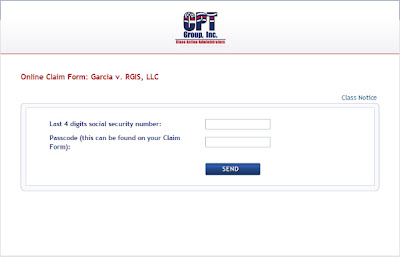
You must already have received a Class Notice If you are a member of the class action. You must file a claim form and must be submitted on or before November 30, 2010 to be included in the settlement. If there will be no objection on the amount of the settlement or objection to any of the provisions stipulated from the settlement, the final approval will push through as scheduled on January 3, 2011.  If you have not submitted a claim form, you may do it online by visiting the link below. Deadline of claim submission is set on November 30, 2010.

When you click the link below, it may ask you to provide a Username and Passowrd to login. The Username is the last 4 digits of your Social Security, and the Password is the number sent to  you from the claim form you received:


If you have further questions, contact:


Garcia, et al. v. RGIS, LLC
c/o CPT Group, Inc.
16630 Aston Street
Irvine, CA 92606
Telephone: (888) 807-5096


What is unique about this Settlement

Unlike the other case filed against the company which involves more than 30,000 hourly employees, this case is unique in 3 ways: First, it involves only the managerial and supervisory positions. Second, it involves much lesser class members than the other case. I assume there are between 300 to 400 class members who participated or will participate in this settlement. It means plaintiff will relatively gets bigger share of the settlment money even if the latter is relatively smaller amount.

Third, in the event that authorized claimants do not claim a minimum of 50% of the net settlement sum (the sum of the settlement after all other deductions such as attorney's fees, administrative fees, etc. have been deducted), the unclaimed amounts up to 50% of the net settlement sum shall be distributed pro data to the authorized claimants.

Any unclaimed amounts remaining after deductions, and after settlements have been paid, it shall go back to RGIS. So folks, claim it or you lose it!


You may also like:


The preceded data are for informational purposes only. No warranty or fitness is implied. It does not solicit, constitute, endorse, or construed to have legal basis, implications, weigh, or merit to a particular case, or any case in dispute.


Wednesday, October 13, 2010

No Further Questions, Your Honor


There is a newer update of the case as of June 20, 2011:

When RGIS offered the $27Million settlement, the company thought that it is in the best interest for both parties. RGIS denies any liability and states that it is entering into the agreement to avoid incurring further litigation costs. I think this is the right thing to do in a defendant's point of view. When a settlement is being offered, both parties can avoid very expensive litigation costs, save precious time, etc. The litigation cost is a major aspect that influences a settlement.

In many settlement cases, the offending party is in the position to offer the settlement, not necessarily because it is in the best interest of both parties but because it is strategically advantageous to the offending party especially when after weighing the evidence, previous court rulings, and the existence of a previous ruling that would point a favorable to judgement to the offended party.

Let me elaborate my point here:

The RGIS lawsuit was resolved partially in favor of the plaintiffs, more than a year ago by the district court (Wren v. RGIS Inventory Specialists, No. C-06-05778, 2009 WL 2612307, (N.D. Cal. Aug. 24, 2009)). In its 2009 opinion, the district court held that RGIS' policy of not paying the plaintiffs for time donning inventory equipment at the start of the workday violated the FLSA. The plaintiffs’ donning of audit machines, handheld scanners and related equipment at the start of the workday “is an activity ‘performed pursuant to RGIS’ mandate, for RGIS’ benefit as an employer,’”  The court then quoted the Alvarez v. I.B.P., Inc., 339 F.3d 894 (9th Cir. 2003) Supreme Court decision, and the donning time was “‘integral and indispensable’” to the RGIS hourly employees' principal activity of conducting physical inventories.

Furthermore, the court ruled that the RGIS’ policy of not compensating RGIS hourly employees for time spent waiting between their donning of the equipment and the beginning of their inventory-related work violated the FLSA because such time is compensable under the “continuous workday” rule. The continuous workday rule is the time that follows an employee’s performance of a principal activity at the start of the workday -- in this case, the donning of inventory equipment -- is compensable under the FLSA (see Alvarez v. I.B.P., Inc., 546 U.S. 21 (2005)).

Based on the opinion of the court, there is an FLSA violation. The court seemed to favor the offended party ( in this case, the RGIS hourly employees). So the natural recourse for the offending party (in this case, RGIS) IS to offer a settlement. That is a good legal move. But there is one question that needs to be settled:

Was the offer from RGIS a reasonable for the Plaintiff?


Image: renjith krishnan / FreeDigitalPhotos.net
That is a $27,000,000.00 question. And that is the exact gross settlement amount that RGIS LLC has offered to the Plaintiffs.

Was the number just magically pop out from nothing and became the basis for compensation? Or did it based on some mathematically feasible formula? Of course there is a basis for coming up such a number. In one side, settlement is computed based on the number of shifts an employee works for the employer, and the frequency of time that lapsed for donning an equipment (which may include wearing the Audit/RM machine, connecting scanner, testing just to make sure the equipment work, changing batteries if necessary, wearing belt bags, pocketing yellow tags, etc.) The other side, settlement may also had been determined based on the gravity of, or the extent of "pain" incurred by RGIS hourly employees. RGIS thought that $27 Million offer is reasonable enough to cover both donning time and employees' grief.

But, what exactly is a reasonable settlement? How do we differentiate between a reasonable, an excessive, or a ridiculous settlement? One might argue that being reasonable means being fair to the offended party. I assume that RGIS was simply negotiating the settlement using a bottom up strategy while the Plainitffs' attorneys are fighting the settlement from the maximum vantage point. I said this because it is a well known fact that most settlement amounts would be slightly lower and cheaper in comparison to the grant ruled by the court. Now, if we use this as a rule of thumb, then chances are, RGIS settlement offer is relatively lower than what should have been reasonable for the Plaintiffs.

And that is the reason why there will be another court hearing on January 2011 to give enough time for possible objections from the Plaintiff before the judge will sign the settlement. If there is no objection on the settlement as currently offered by RGIS on or before the next scheduled hearing on January 2011, then the offer IS reasonable. Judge Spero shall sign the final approval of the settlement on the date specified.

However, if majority of the class and/or Plaintiff's attorney object to the amount of settlement, then final approval of the settlement may be delayed.


Supreme Court ruling on IPB v. ALVAREZ:

The preceded data are for informational purposes only. No warranty or fitness is implied. It does not solicit, constitute, endorse, or construed to have legal basis, implications, weigh, or merit to a particular case, or any case in dispute.


Related Posts:


You may also like:

Wholesale Justice: Constitutional Democracy and the Problem of the Class Action Lawsuit (Stanford Law Books)  Harm Less Lawsuits?: What's Wrong with Consumer Class Actions (Aei Liability Studies) The Oxford Guide to United States Supreme Court Decisions  Landmark Supreme Court Cases: The Most Influential Decisions of the Supreme Court of the United States

Friday, October 08, 2010

Best Buy employees get $900,000 settlement for unpaid wages


Electronics retail giant, Best Buy has agreed to settle a lawsuit filed by former and current employees for  working time not being properly compensated amounting to $902,410.00 plus other non-monetary relief and the costs of administration.

That working time in dispute was the minutes spent going through security clearings at the end of the work day, AFTER employees have been clocked out for their shift AND for failure to pay them working thru breaks. The case was filed in October 2008 on behalf of current and former employees who worked at any of the 25 Best buy stores in Pennsylvania since October 2003. But the company maintained that it properly paid all employees for all time worked, and denied any culpability.  The case is entitled Turner v. Best Buy Company, Inc.

The plaintiff argued that going through the security check was an employer mandated “activity” that required compensation. According to the lawsuit, workers sometimes wait up to 15 minutes to be searched after each shift. The Plaintiff's lawyers also contend that in this particular case, going through the security clearings is a postliminary activity and therefore compensable. Read Atty. Gerald Lawrence of Lowey Dannenberg Cohen & Hart, P.C., Plaintiff's Law Office for more details of the case.

The class action settlement was granted on February 19, 2010, and final approval hearing is scheduled November 2010.


How to determine if a preliminary or postliminary activity is compensable

Image from renjith krishnan / FreeDigitalPhotos.net
Many of us in some way, have undergone similar experiences when our employers or managers have required us to do something related to our principal activity off-the-clock, and we know that we deserve compensation, but we weren't.

The inventory industry is replete with such cases. You are probably silent about your own case or at least waiting for other co-workers who have similar cases and ramp up a class action lawsuit then join the fray later on.

The law is clear that an employer must pay employees for principal activities AND for preliminary activities at the beginning of the day and postliminary activities at the end of the day, as long as the preliminary and postliminary activities are integral to the employees' principal activities. If a preliminary or postliminary activity is found to be integrally related, then generally every activity after or before it is compensable under the "continuous workday" rule.

To determine whether preliminary or postliminary activities are compensable is the element of employer compulsion or the lack thereof. It asks the question, "Did your employer require you to perform the activity?" The other element is how integrally related to the main job is the side activity. It asks the question, "Is the activity in question an integral part of your principal activity?" If both answers to the questions are yes, then your preliminary and postliminary activities could be compensable.

To give an example of Continuous Workday Rule, and definition of preliminary and postliminary activities,  read a Supreme Court landmark decision on IBP v. Alvarez (546  U.S. 21 (2005)) and Rutti v. Lojack on off-the-clock compensability

So, what do you think, do you have a case?

Related Stories:

You may also like:


Workers' Compensation Law  Ultimate Guide to Workers' Compensation Insurance (Entrepreneur Magazine's Ultimate Books) Solving the Compensation Puzzle: Putting Together a Complete Pay and Performance System (Practical Hr Series) The Complete Guide to Sales Force Incentive Compensation: How to Design and Implement Plans That Work


    Sunday, September 26, 2010

    RGIS Settles Lawsuit for $27 Million

    Image from: renjith krishnan / FreeDigitalPhotos.net
    New Post as July 29, 2011: Settlement Delayed Part 6: Checks Are Here!

    Judge Spero signs Motion to Settle FLSA collective action

    RGIS LLC has agreed to pay out a $27 million settlement in a collective action that includes around 30,000 former and current RGIS hourly employees. The settlement was a result of the charge that RGIS LLC has allegedly violated the Federal Fair Labor Standards Act (FLSA) and the wage and hour laws of California, Illinois, Oregon, and Washington by failing to properly pay and comply all wages including donning of equipment and pre-inventory waiting time.

    Former and current RGIS hourly employees have been seeking compensation for all hours worked, and obtaining injunctive relief to prevent future violations by RGIS.

    The court has scheduled a hearing for final approval of the settlement on January 28, 2011.


    A quick timeline and important events of the case:


    Please visit, Updates on the Class Action Lawsuit for a complete timeline of the case.
    • January 28, 2011. The courts sets this date for final approval of the settlement.
    • September 2010. RGIS LLC agrees to pay out a $27 million settlement in a nationwide wage-and-hour collective action that includes around 30,000 RGIS hourly employees.
    • August 2010. Finally, after almost a year of silence about the case, there is a possible settlement of the case that needs to be approved by the Court. If the Court approves the settlement, you will be getting a notice by mail within 60 days. The amount of the settlement will depend on each person's length of employment, hours worked along with other factors.
    • August 2009. A federal judge has dismissed commute time claims in a wage-and-hour class action against RGIS LLC, but kept alive claims related to donning and waiting time.
    • June 2009. The court of Appeals has denied RGIS' request to appeal the trial court's ruling on class certification. The court also denied RGIS' motion to decertify plaintiff's claims for donning and pre-inventory waiting time claims. A judge has agreed to drop certain late-filing opt-in plaintiffs from an employment class action against leading retail inventory and data collection firm RGIS LLC alleging that the company fails to pay workers for time spent traveling to job sites or donning equipment.
    • February 2009. A court order has granted motion for class certification in favor of the Plaintiff and denied RGIS' motion for decertification.
    • January 2009. Judge Joseph Spero, held a hearing on Plaintiff's Motion for class certification and Defendant's Motion for Decertification.


    The big question remains: Will the lawyers of the Plaintiff agree with the $27 Million settlement offer from RGIS LLC? That question remains to be settled first.


    Related Article and Link: 

    Related Posts Plugin for WordPress, Blogger...