Search this Site

Showing posts with label Compensation. Show all posts

Saturday, February 25, 2012

Postal Service Cuts 35,000 Jobs This Year


Planning to look for a job at USPS? Not a good idea.

Because USPS plans to close or consolidate more than 250 processing plants starting May or June. That speaks more than 35,000 jobs in danger of lay offs this year. The job cuts would include 30,000 full time positions and 5,000 non career employees. In the State of Washington alone where I live, it plans to cut more than 300 jobs

Wonder if how many processing plants will shut down in your city? Read this complete list (in PDF)

Sunday, February 13, 2011

Settlement Delayed, Settlement Denied?

Image from Rust Consulting website

Last January 28, 2011 the fairness hearing was held and the final settlement offer has been accepted both by the Plaintiffs and their counsel. However, the court has granted a 30-day grace period for Rust Consulting, the claims administrator to give time to correct any further issues related to claims and claims eligibility. Issues were raised after some eligible claimants particularly in the State of Oregon, found that their names were not included in the original claimants' list.

When that grace period lapses on March 25, 2011 and ALL issues have been addressed, then that will only be the time claims can be mailed out, possibly on April or depending on the prevailing circumstances on those dates.

There will be changes on the amount that you will receive from the settlement. If you look at Section 8 of the Official Court Notice that was mailed out to you late last year, it tells you the amount you most likely to receive. But because of additional claimants that Rust Consulting may include with the claims list, your share of the settlement may decrease as well. But not significant according to the Claims Administrator.

I would like also to dispel some misconceptions being raised by some. Yes, claimants can receive settlement share not lower than $25 based on the stipulated agreement. But some of you may receive $250 or even $2,500 if you get lucky. But surprisingly, there are claimants in Washington State and in California that can get more than $8,527.70 per individual. So again, your settlement share boils down to the length of your employment and the number of shifts you have worked with RGIS LLC.

So for those of you who may have issues with claims eligibility, change of address, or you need to update your personal information, you still have a short window time to make such changes. Do it now by calling

Rust Consulting Toll Free: 1-877-310-2748

This post is for informational use only. The author disclaims any legal capacity, nor represents any of the parties involved in this case. 

Related Links:

Saturday, October 30, 2010

RGIS Managers get $600,000 in another settlement

A Los Angeles Superior Courthouse in downtown Los Angeles

Just very recently, RGIS LLC settles another lawsuit, (with case No. BC425624: Garcia et al v. RGIS LLC) filed against the company by current and former RGIS District Managers, Area Managers and Supervisors (Team Leaders) in the State of California for an alleged failure of the company to reimburse them for work related expenses.

RGIS settles the case for a maximum of $600,000 which include attorney's fees, and other administrative settlement fees. The net settlement sum will be distributed for every class member who participated in the class action, or will opt in for the settlement. The Los Angeles County Superior Court granted a Preliminary Approval of the Settlement on August 27, 2010. The Final Approval Hearing will be on January 3, 2011.

The summary and the settlement

On November 9, 2009, Rebecca Garcia and others similarly situated filed a complaint against the company in the Superior Court of California. Rebacca Garica et al ("Plaintiffs") claims that RGIS LLC has failed to reimburse employees of RGIS in California at any time from November 9, 2005 through May 2010 for "work related expenses." The Plaintiff seek damages, restitution and injunction relief, among others. Five months after the case was filed, both parties have agreed settle the case and RGIS offered $600,000 maximum as settlement.

RGIS has denied and continue to deny all allegations.

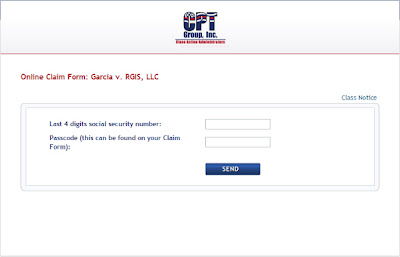
You must already have received a Class Notice If you are a member of the class action. You must file a claim form and must be submitted on or before November 30, 2010 to be included in the settlement. If there will be no objection on the amount of the settlement or objection to any of the provisions stipulated from the settlement, the final approval will push through as scheduled on January 3, 2011.  If you have not submitted a claim form, you may do it online by visiting the link below. Deadline of claim submission is set on November 30, 2010.

When you click the link below, it may ask you to provide a Username and Passowrd to login. The Username is the last 4 digits of your Social Security, and the Password is the number sent to  you from the claim form you received:


If you have further questions, contact:


Garcia, et al. v. RGIS, LLC
c/o CPT Group, Inc.
16630 Aston Street
Irvine, CA 92606
Telephone: (888) 807-5096


What is unique about this Settlement

Unlike the other case filed against the company which involves more than 30,000 hourly employees, this case is unique in 3 ways: First, it involves only the managerial and supervisory positions. Second, it involves much lesser class members than the other case. I assume there are between 300 to 400 class members who participated or will participate in this settlement. It means plaintiff will relatively gets bigger share of the settlment money even if the latter is relatively smaller amount.

Third, in the event that authorized claimants do not claim a minimum of 50% of the net settlement sum (the sum of the settlement after all other deductions such as attorney's fees, administrative fees, etc. have been deducted), the unclaimed amounts up to 50% of the net settlement sum shall be distributed pro data to the authorized claimants.

Any unclaimed amounts remaining after deductions, and after settlements have been paid, it shall go back to RGIS. So folks, claim it or you lose it!


You may also like:


The preceded data are for informational purposes only. No warranty or fitness is implied. It does not solicit, constitute, endorse, or construed to have legal basis, implications, weigh, or merit to a particular case, or any case in dispute.


Wednesday, October 13, 2010

No Further Questions, Your Honor


There is a newer update of the case as of June 20, 2011:

When RGIS offered the $27Million settlement, the company thought that it is in the best interest for both parties. RGIS denies any liability and states that it is entering into the agreement to avoid incurring further litigation costs. I think this is the right thing to do in a defendant's point of view. When a settlement is being offered, both parties can avoid very expensive litigation costs, save precious time, etc. The litigation cost is a major aspect that influences a settlement.

In many settlement cases, the offending party is in the position to offer the settlement, not necessarily because it is in the best interest of both parties but because it is strategically advantageous to the offending party especially when after weighing the evidence, previous court rulings, and the existence of a previous ruling that would point a favorable to judgement to the offended party.

Let me elaborate my point here:

The RGIS lawsuit was resolved partially in favor of the plaintiffs, more than a year ago by the district court (Wren v. RGIS Inventory Specialists, No. C-06-05778, 2009 WL 2612307, (N.D. Cal. Aug. 24, 2009)). In its 2009 opinion, the district court held that RGIS' policy of not paying the plaintiffs for time donning inventory equipment at the start of the workday violated the FLSA. The plaintiffs’ donning of audit machines, handheld scanners and related equipment at the start of the workday “is an activity ‘performed pursuant to RGIS’ mandate, for RGIS’ benefit as an employer,’”  The court then quoted the Alvarez v. I.B.P., Inc., 339 F.3d 894 (9th Cir. 2003) Supreme Court decision, and the donning time was “‘integral and indispensable’” to the RGIS hourly employees' principal activity of conducting physical inventories.

Furthermore, the court ruled that the RGIS’ policy of not compensating RGIS hourly employees for time spent waiting between their donning of the equipment and the beginning of their inventory-related work violated the FLSA because such time is compensable under the “continuous workday” rule. The continuous workday rule is the time that follows an employee’s performance of a principal activity at the start of the workday -- in this case, the donning of inventory equipment -- is compensable under the FLSA (see Alvarez v. I.B.P., Inc., 546 U.S. 21 (2005)).

Based on the opinion of the court, there is an FLSA violation. The court seemed to favor the offended party ( in this case, the RGIS hourly employees). So the natural recourse for the offending party (in this case, RGIS) IS to offer a settlement. That is a good legal move. But there is one question that needs to be settled:

Was the offer from RGIS a reasonable for the Plaintiff?


Image: renjith krishnan / FreeDigitalPhotos.net
That is a $27,000,000.00 question. And that is the exact gross settlement amount that RGIS LLC has offered to the Plaintiffs.

Was the number just magically pop out from nothing and became the basis for compensation? Or did it based on some mathematically feasible formula? Of course there is a basis for coming up such a number. In one side, settlement is computed based on the number of shifts an employee works for the employer, and the frequency of time that lapsed for donning an equipment (which may include wearing the Audit/RM machine, connecting scanner, testing just to make sure the equipment work, changing batteries if necessary, wearing belt bags, pocketing yellow tags, etc.) The other side, settlement may also had been determined based on the gravity of, or the extent of "pain" incurred by RGIS hourly employees. RGIS thought that $27 Million offer is reasonable enough to cover both donning time and employees' grief.

But, what exactly is a reasonable settlement? How do we differentiate between a reasonable, an excessive, or a ridiculous settlement? One might argue that being reasonable means being fair to the offended party. I assume that RGIS was simply negotiating the settlement using a bottom up strategy while the Plainitffs' attorneys are fighting the settlement from the maximum vantage point. I said this because it is a well known fact that most settlement amounts would be slightly lower and cheaper in comparison to the grant ruled by the court. Now, if we use this as a rule of thumb, then chances are, RGIS settlement offer is relatively lower than what should have been reasonable for the Plaintiffs.

And that is the reason why there will be another court hearing on January 2011 to give enough time for possible objections from the Plaintiff before the judge will sign the settlement. If there is no objection on the settlement as currently offered by RGIS on or before the next scheduled hearing on January 2011, then the offer IS reasonable. Judge Spero shall sign the final approval of the settlement on the date specified.

However, if majority of the class and/or Plaintiff's attorney object to the amount of settlement, then final approval of the settlement may be delayed.


Supreme Court ruling on IPB v. ALVAREZ:

The preceded data are for informational purposes only. No warranty or fitness is implied. It does not solicit, constitute, endorse, or construed to have legal basis, implications, weigh, or merit to a particular case, or any case in dispute.


Related Posts:


You may also like:

Wholesale Justice: Constitutional Democracy and the Problem of the Class Action Lawsuit (Stanford Law Books)  Harm Less Lawsuits?: What's Wrong with Consumer Class Actions (Aei Liability Studies) The Oxford Guide to United States Supreme Court Decisions  Landmark Supreme Court Cases: The Most Influential Decisions of the Supreme Court of the United States

Friday, October 08, 2010

Best Buy employees get $900,000 settlement for unpaid wages


Electronics retail giant, Best Buy has agreed to settle a lawsuit filed by former and current employees for  working time not being properly compensated amounting to $902,410.00 plus other non-monetary relief and the costs of administration.

That working time in dispute was the minutes spent going through security clearings at the end of the work day, AFTER employees have been clocked out for their shift AND for failure to pay them working thru breaks. The case was filed in October 2008 on behalf of current and former employees who worked at any of the 25 Best buy stores in Pennsylvania since October 2003. But the company maintained that it properly paid all employees for all time worked, and denied any culpability.  The case is entitled Turner v. Best Buy Company, Inc.

The plaintiff argued that going through the security check was an employer mandated “activity” that required compensation. According to the lawsuit, workers sometimes wait up to 15 minutes to be searched after each shift. The Plaintiff's lawyers also contend that in this particular case, going through the security clearings is a postliminary activity and therefore compensable. Read Atty. Gerald Lawrence of Lowey Dannenberg Cohen & Hart, P.C., Plaintiff's Law Office for more details of the case.

The class action settlement was granted on February 19, 2010, and final approval hearing is scheduled November 2010.


How to determine if a preliminary or postliminary activity is compensable

Image from renjith krishnan / FreeDigitalPhotos.net
Many of us in some way, have undergone similar experiences when our employers or managers have required us to do something related to our principal activity off-the-clock, and we know that we deserve compensation, but we weren't.

The inventory industry is replete with such cases. You are probably silent about your own case or at least waiting for other co-workers who have similar cases and ramp up a class action lawsuit then join the fray later on.

The law is clear that an employer must pay employees for principal activities AND for preliminary activities at the beginning of the day and postliminary activities at the end of the day, as long as the preliminary and postliminary activities are integral to the employees' principal activities. If a preliminary or postliminary activity is found to be integrally related, then generally every activity after or before it is compensable under the "continuous workday" rule.

To determine whether preliminary or postliminary activities are compensable is the element of employer compulsion or the lack thereof. It asks the question, "Did your employer require you to perform the activity?" The other element is how integrally related to the main job is the side activity. It asks the question, "Is the activity in question an integral part of your principal activity?" If both answers to the questions are yes, then your preliminary and postliminary activities could be compensable.

To give an example of Continuous Workday Rule, and definition of preliminary and postliminary activities,  read a Supreme Court landmark decision on IBP v. Alvarez (546  U.S. 21 (2005)) and Rutti v. Lojack on off-the-clock compensability

So, what do you think, do you have a case?

Related Stories:

You may also like:


Workers' Compensation Law  Ultimate Guide to Workers' Compensation Insurance (Entrepreneur Magazine's Ultimate Books) Solving the Compensation Puzzle: Putting Together a Complete Pay and Performance System (Practical Hr Series) The Complete Guide to Sales Force Incentive Compensation: How to Design and Implement Plans That Work


    Sunday, September 26, 2010

    RGIS Settles Lawsuit for $27 Million

    Image from: renjith krishnan / FreeDigitalPhotos.net
    New Post as July 29, 2011: Settlement Delayed Part 6: Checks Are Here!

    Judge Spero signs Motion to Settle FLSA collective action

    RGIS LLC has agreed to pay out a $27 million settlement in a collective action that includes around 30,000 former and current RGIS hourly employees. The settlement was a result of the charge that RGIS LLC has allegedly violated the Federal Fair Labor Standards Act (FLSA) and the wage and hour laws of California, Illinois, Oregon, and Washington by failing to properly pay and comply all wages including donning of equipment and pre-inventory waiting time.

    Former and current RGIS hourly employees have been seeking compensation for all hours worked, and obtaining injunctive relief to prevent future violations by RGIS.

    The court has scheduled a hearing for final approval of the settlement on January 28, 2011.


    A quick timeline and important events of the case:


    Please visit, Updates on the Class Action Lawsuit for a complete timeline of the case.
    • January 28, 2011. The courts sets this date for final approval of the settlement.
    • September 2010. RGIS LLC agrees to pay out a $27 million settlement in a nationwide wage-and-hour collective action that includes around 30,000 RGIS hourly employees.
    • August 2010. Finally, after almost a year of silence about the case, there is a possible settlement of the case that needs to be approved by the Court. If the Court approves the settlement, you will be getting a notice by mail within 60 days. The amount of the settlement will depend on each person's length of employment, hours worked along with other factors.
    • August 2009. A federal judge has dismissed commute time claims in a wage-and-hour class action against RGIS LLC, but kept alive claims related to donning and waiting time.
    • June 2009. The court of Appeals has denied RGIS' request to appeal the trial court's ruling on class certification. The court also denied RGIS' motion to decertify plaintiff's claims for donning and pre-inventory waiting time claims. A judge has agreed to drop certain late-filing opt-in plaintiffs from an employment class action against leading retail inventory and data collection firm RGIS LLC alleging that the company fails to pay workers for time spent traveling to job sites or donning equipment.
    • February 2009. A court order has granted motion for class certification in favor of the Plaintiff and denied RGIS' motion for decertification.
    • January 2009. Judge Joseph Spero, held a hearing on Plaintiff's Motion for class certification and Defendant's Motion for Decertification.


    The big question remains: Will the lawyers of the Plaintiff agree with the $27 Million settlement offer from RGIS LLC? That question remains to be settled first.


    Related Article and Link: 

    Thursday, August 26, 2010

    Inventory Clerks win $433,000 in back wages from Walt Disney World


    The U.S Department of Labor's Wage and Hour Division has ordered The Walt Disney Co. to pay 69 inventory clerks the amount of $433,000 in back wages after the company was found to have violated the Fair Labor Standards Act.

    The decision was based on the complaint filed by the employees where they charged Walt Disney for not paying them for work done before and after their regular shifts, during meal times and when working from home. The inventory employees are assigned to work for the park's food and beverage department.

    According to the investigation conducted by a US Department of Labor representative, it found out that Food and Beverage managers were not adhering to internal policies regarding off-the-clock work. Wage and Hour Deputy Administrator Nancy Leppink explicitly stated that, "It is not enough to have policies. Management must also ensure that all supervisors are implementing them."


    FLSA rules on Hourly Wage
    The FLSA requires that covered employees be paid time and one-half their regular rates of pay, including commissions, bonuses, and incentive pay, for hours worked over 40 per week. The term "hours worked" includes all time an employee must be on duty, or on the employer's premises or at any other prescribed place of work, from the beginning of the first principal activity of the workday to the end of the last principal work activity of the workday.

    Furthermore, the law requires that accurate records of employees' wages, hours and other conditions of employment be maintained. The current federal minimum wage for covered, nonexempt employees is $7.25 per hour.

    It is very interesting to note that when big companies become negligent of their responsibilities to their employees, they become prone and subject to lawsuits, and other settlement cases.

    For a more detailed story, visit the DoL press release here.


    Do you have a similar case?
    If you have issues with compensation, overtime pay, or questions about hours worked, and believed that you have not been reasonably paid, or that your employer violates FLSA regulations, you may call the US Department of Labor's Wage and Hour Department toll-free helpline at 866-4US-WAGE (487-9243).

    For a wealth of information on Wages and Hours, visit: http://www.dol.gov/whd

    For RGIS employees, there is an ongoing lawsuit on compensation issues:

    Updates on Lawsuit Against RGIS on Overtime

    -------------------------------------------------------------------------------------------


    You may also like:

    The FLSA: A User's Manual  Understanding the Federal Wage & Hour Laws: What Employers Must Know about the FLSA and Its Overtime Regulations  Understanding Fair Labor Standards Act Violations: Leading Lawyers on Examining FLSA Trends and Developing Defense Strategies for Collective and Class Actions (Inside the Minds)  The Unofficial Guide Walt Disney World 2010 (Unofficial Guides)
    Related Posts Plugin for WordPress, Blogger...